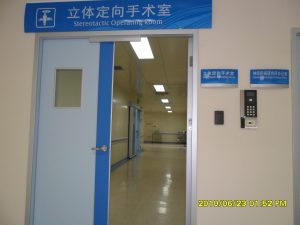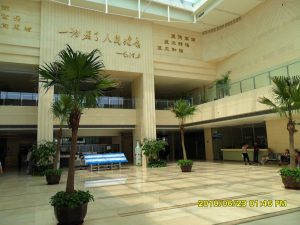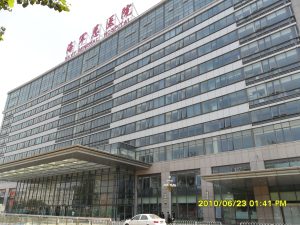
Neurosurgery Department was authorized to become PLA Neurosurgery Center in 1992 and become Navy Institute of Neurology and Neurosurgery in 2000, which is a training base for Master’s and Ph.D. students. The Center has two experts in epilepsy, who are receiving allowance from the State Council, two doctors with senior titles and 17 doctors hold their M.D. or Master’s degree, respectively. The Center is equipped with state-of-the-art instruments and equipments and is at the top level of application of stem cell technology. The Center consisted of four clinical operation groups including functional neurosurgery, intracranial tumors, brain endoscope and repairing of spinal cord injury. In addition, it has a Gamma Knife Center, a microelectrode therapy center, a stereotaxic operation division, a brain electrophysiology division and a stem cell division. The Center has 70 beds, about 8000 outpatients and 1200 inpatients yearly and conducts 1500 operations yearly. It has received 30 awards from state and the PLA including 12 secondary awards. The stem cell transplantation with robot-aided brain stereotaxic technology has received second prize for army medicine and Chinese medical prize in 2002. The Center is engaged in 36 research projects including those from National 863 Program and 973 Program and military research programs.
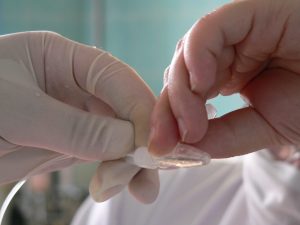
On Nov. 3, 2009, Premier Wen Jiabao pointed out that stem cells promote regenerative medicine which represents a revolution in medicine after medication and surgical treatments. The Center has been conducting stem cell transplantation for more than 10 years since the first stem cell transplantation operated in the world in 1988. There have been near 10000 cases of stem cell transplantation conducted at the Center and good clinical results have been obtained in terms of safety and effectiveness for treatment of epilepsy and some functional diseases.
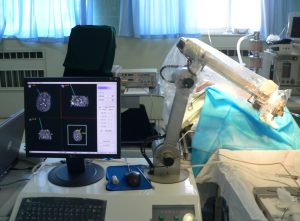
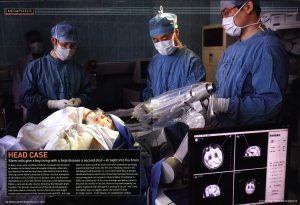
The Center has cooperated with Chinese Institute of Space Industry to develop the first robot which can be used in stem cell transplantation for treatment of epilepsy. The epileptic focus is destroyed with robot-assisted stereotaxic technology and then to transplant the stem cells into the intracranial focus to repair the damaged neural cells. The patients will have a wound smaller than a pencil lead on his/her head. The remarkable advantage of robot-assisted stereotaxic operation is precisely positioning (the error will be less than 0.5 mm) and the transplanted stem cells can replace the damaged brain cells to cure epilepsy completely.
The Center conducted the first robot-assisted stereotaxic operation in the world in 1997. Until now, this kind of operations, without invasion to position and frameless, have been successfully conducted for over 10000 cases.